


Why Central Banks Are Bringing Gold Closer to Home, and What It Tells the Rest of Us
Central banks bought 289 tonnes of gold in Q2 2026, and more of them are keeping it closer to home. Here is what they know, and what it means for you.

I’m Stephen Pfeil, founder of Global Coin, and I have spent more than 25 years watching the gold market. Prices go up and down. What rarely changes is who is buying, and why. Right now the most important buyers in the world are not hedge funds or day traders. They are central banks. And what they are doing is worth your attention.
The Numbers

According to the World Gold Council’s Gold Demand Trends report for the second quarter of 2026, central banks added 289 tonnes of gold between April and June. That was up 62% from the same quarter a year earlier, roughly five times their first-quarter total, and the strongest second quarter in the Council’s records.
They did it in a quarter when the gold price was falling. Most buyers chase a rising market. Central banks bought more on the way down.
This is not a one-quarter story. The Council’s 2026 central bank survey notes that central banks have bought an average of about 1,000 tonnes a year for the past four years. That is double the average of the decade before.
And they say they are not finished:
- 89% of central banks surveyed expect global central bank gold reserves to rise over the next 12 months.
- A record 45% expect their own institution’s gold holdings to increase.
- Only 1% expect their own reserves to fall.
That is not rotation. That is conviction.
What Changed in 2022

When roughly $300 billion of Russia’s foreign reserves were frozen after the invasion of Ukraine, every reserve manager in the world took note. Reserves held as foreign currency or foreign bonds, even U.S. dollars, suddenly looked less like a safe harbor and more like something another government could switch off.
Gold is different. A bar of gold in your own vault is not someone else’s liability. It cannot be frozen with a keystroke, and it does not depend on another country’s permission to use.
You can see the shift in the numbers. Before 2022, central bank buying was steady but modest. Since then it has stayed at roughly twice the old pace, year after year.
Where They Keep It Matters, Too
Here is where the story gets more interesting. It is not just how much gold central banks are buying. It is where they are putting it.
The Bank of England is still the most popular vault, used by 57% of the central banks the World Gold Council surveyed. But 49% now hold at least some of their gold at home, and the number making changes is rising:
- 9% said they increased domestic storage over the past year, up from 5% the year before.
- 10% said they spread their overseas holdings across more locations, up from just 2%.
Poland is the clearest example. It brought a large portion of its gold back to Warsaw years ago, and in the second quarter of 2026 it was the world’s largest buyer again, adding 51 tonnes and bringing its reserves to 632 tonnes. It has said publicly it wants to reach 700. China added 33 tonnes in the same quarter, its largest quarterly addition since late 2023. Uzbekistan, Kazakhstan, the Czech Republic and Jordan were also buyers.
The logic is simple. If you are holding gold because you want an asset no one else can control, you want to know exactly where it is and that you can reach it in a crisis. And you do not want all of it in one place.
That is not panic. That is careful risk management.
Why They Buy

In the World Gold Council’s survey, central banks keep returning to the same reasons:
- It holds its value over time. Gold has protected purchasing power through every currency regime in modern history.
- It performs in a crisis. Gold is accepted everywhere and owes nothing to anyone.
- It diversifies away from any one currency. Holding gold reduces reliance on the dollar, the euro or any other single government’s money.
Central banks do not move on hunches. They plan in decades, not weeks. When the institutions that manage national reserves keep adding to one asset, year after year, at twice their old pace, I pay attention.
What It Means for You

You do not need to be a central bank to apply the same thinking. In fact, the principles translate almost word for word:
- Own what you can hold. Physical gold, in your possession, carries no counterparty.
- Know where it is. Whether it is in a home safe, a safe deposit box or a reputable depository, you should be able to answer that question without hesitating.
- Don’t keep it all in one place. Central banks spread their gold across vaults. Spreading your holdings across locations, and across sizes, makes sense for the same reason.
- Understand why you own it. Gold is a foundation, not a lottery ticket.
If you are new to gold, start with the basics. I wrote about how to buy gold coins from 25 years in the business, and compared the two most popular bullion coins in Krugerrand vs. American Gold Eagle. For the bigger picture on physical metal versus paper claims, read Paper Promises vs. Physical Reality: Why China Just Shut Down Paper Gold, and Gold Measured in Trust for why I think trust, not just inflation, drives the gold price.
The Takeaway
Central banks are buying more gold than at any time in decades. More of them are keeping it closer to home, and more are spreading it across locations. They are doing it because the risks they are protecting against, from frozen reserves to currency debasement to geopolitical shocks, are not theoretical.
Gold has lasted thousands of years for a reason. It is not because it glitters. It is because it endures.
If you would like to talk through how gold fits into your own plans, as a foundation rather than a speculation, call us at 1-844-595-9599. And if you would like the fundamentals in one place, request a free copy of my Guide to Gold.
— Stephen Pfeil, Founder, Global Coin
Sources: World Gold Council, Gold Demand Trends Q2 2026 (July 30, 2026); World Gold Council, Central Bank Gold Reserves Survey 2026.
Global Coin is a dealer of precious metal coins and does not provide investment, financial, or legal advice. Past performance is not indicative of future results. Please consult a qualified advisor before making investment decisions.
Related Articles

Why Central Banks Are Bringing Gold Closer to Home, and What It Tells the Rest of Us
Central banks bought 289 tonnes of gold in Q2 2026, and more of them are keeping it closer to hom...
Discover More
The U.S. Mint's first 24-karat gold proof coin to feature a sitting president: one ounce of pure ...
Discover More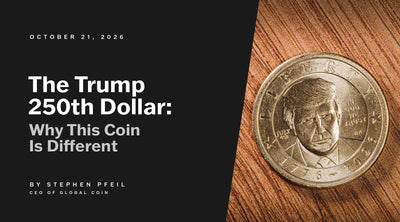
The Trump 250th Dollar: Why This Coin Is Different
I’m Stephen Pfeil, founder of Global Coin. There are coins you collect, and there are coins peopl...
Discover More

Leave a comment
This site is protected by hCaptcha and the hCaptcha Privacy Policy and Terms of Service apply.