

The 2026 Semiquincentennial 10-Piece Silver Proof Set: A Deep Dive Into America's 250th Anniversary
Key Takeaways The 2026 Semiquincentennial Silver Proof Set is the U.S. Mint's official commemoration of America's 250th birthday — the first Semiquincentennial in U.S. history. All ten coins are struck at the historic San Francisco Mint. The dime, five quarters,...

Key Takeaways
- The 2026 Semiquincentennial Silver Proof Set is the U.S. Mint's official commemoration of America's 250th birthday — the first Semiquincentennial in U.S. history.
- All ten coins are struck at the historic San Francisco Mint. The dime, five quarters, and half dollar are 99.9% silver; the penny, nickel, and Native American $1 complete the set in their standard proof alloys.
- Every coin in this set is individually certified NGC PF70 Ultra Cameo First Day of Issue — the highest possible grade, applied to first-strike coins released within 24 hours of the official issue date.
- The set introduces the first redesign of the dime obverse in 80 years (since 1946) and the first non-Kennedy half dollar since 1964 — two of the most historically significant U.S. coin design changes in living memory.
- The Jefferson Nickel and Lincoln Cent in this set carry the first-ever dual dates in either series — a numismatic first for two of the most collected coins in American history.
- The five Semiquincentennial Quarters tell the story of American independence in chronological order: Mayflower Compact → Revolutionary War → Declaration → Constitution → Gettysburg Address.
A Personal Note Before We Begin

In 25 years of handling coins, I've watched a lot of commemorative programs come and go. Most of them fade. A few — the 1976 Bicentennial Quarters, the 50 State Quarters, the 2009 Lincoln Bicentennial cents — become permanent fixtures in American numismatics, the coins that grandparents pull out of drawers 40 years later and hand to their grandkids.
The 2026 Semiquincentennial program is going to be one of those.
I don't say that lightly. This isn't a marketing set dressed up in patriotic packaging. It is the most sweeping, coordinated commemorative coinage program the United States has issued since 1976 — and arguably, when you weigh the design changes it introduces, the most historically significant coin release of my adult life. The dime obverse hasn't changed since Franklin Roosevelt was replaced by Liberty in this issue. The half dollar hasn't shown anyone other than John F. Kennedy since 1964. Both change here. Both change on coins struck for the 250th birthday of the country.
This set — ten coins, graded PF70 Ultra Cameo, First Day of Issue — is the definitive way to own it. Let me walk you through what's inside, what it means, and why I'm putting one in my own collection.
Historical Context: What "Semiquincentennial" Actually Means
Semiquincentennial is a mouthful. It means the 250th anniversary. Half of a quincentennial (500 years). It marks 250 years since the signing of the Declaration of Independence on July 4, 1776.
To put that in perspective:
- 1876 — the Centennial. The Mint issued the Trade Dollar and a modest Centennial medal. The Philadelphia Centennial Exposition was the big event; coinage played a supporting role.
- 1926 — the Sesquicentennial. The Mint issued a commemorative half dollar and a $2.50 quarter eagle for the 150th, both scarce today and highly collectible. Small program.
- 1976 — the Bicentennial. This is the one most Americans remember. Special reverse designs on the quarter (drummer boy), half dollar (Independence Hall), and dollar (Liberty Bell over the moon). Struck in massive numbers for circulation and in 40% silver proof sets. Nearly every American household from that era had at least one.
-
2026 — the Semiquincentennial. The program dwarfs 1976 in scope. Instead of three redesigned reverses, we get ten redesigned coins across the entire circulating and numismatic lineup — with the U.S. Mint deliberately revisiting Liberty as an obverse figure for the first time in generations.
The Mint understood the assignment. They didn't produce a modest commemorative and call it a day. They rebuilt the coinage.
What's Actually in the Set

Ten coins, all struck at San Francisco, all certified NGC PF70 Ultra Cameo First Day of Issue. Here's what you get, and why each one matters.
Per the United States Mint, all ten are proof. The dime, quarters, and half dollar are 99.9% silver. The penny is 2.5% copper, balance zinc. The nickel is 25% nickel, balance copper. The Native American $1 is 6% zinc, 3.5% manganese, 2% nickel, balance copper.
1. Emerging Liberty Dime — .999 Fine Silver
The headline coin of the entire program.
For the first time since 1946 — 80 years — Lady Liberty returns to the obverse of the American dime. Franklin Delano Roosevelt has held that spot uninterrupted since his death; before him, it was the Winged Liberty ("Mercury") dime designed by Adolph Weinman.
The new Emerging Liberty depicts Liberty as a determined young woman wearing a stars-and-stripes Liberty cap, the winds of revolution blowing through her hair. The reverse shows an eagle carrying arrows in its talons — the colonists' fight for independence — inscribed LIBERTY OVER TYRANNY.
Why this matters: Liberty as an allegorical figure defined U.S. coinage from 1793 until the early 20th century. The gradual replacement of Liberty with presidential portraits (Lincoln 1909, Washington 1932, Jefferson 1938, Roosevelt 1946, Franklin/Kennedy 1948-1964) is one of the most-debated shifts in American numismatic history. Bringing Liberty back — even for a commemorative year — is a statement. It's the Mint acknowledging what generations of collectors have been asking for.
2. Enduring Liberty Half Dollar — .999 Fine Silver
The first non-Kennedy half dollar since 1964.
President Kennedy has appeared on every half dollar struck since his assassination — 62 years of unbroken presence. That ends here.
The Enduring Liberty obverse portrays the Statue of Liberty in exquisite detail. The reverse depicts Lady Liberty passing her torch to a new generation, inscribed KNOWLEDGE IS THE ONLY GUARDIAN OF TRUE LIBERTY — a paraphrase of the Jefferson quote most collectors will recognize.
This is the coin that will draw the most attention from the general public. Kennedy halves are baked into American consciousness. Replacing him, even for a year, is going to be discussed. That discussion is what makes this coin a long-term keeper.
3-7. The Five Semiquincentennial Quarters — .999 Fine Silver
The five quarters tell the story of American independence in chronological order. This is the narrative arc of the set. Each obverse honors a defining figure; each reverse depicts a defining moment or symbol.
Mayflower Compact Quarter
Obverse: Two Pilgrims embracing as they behold the shores of the New World. Reverse: The Mayflower under full sail crossing rough seas. Historical weight: The Mayflower Compact (1620) is widely regarded as a foundational precursor to the Declaration of Independence and the Constitution — one of the earliest documented expressions of self-governance in the New World. Setting the story here is deliberate: independence didn't start in 1776, it started 156 years earlier.
Revolutionary War Quarter
Obverse: George Washington as Commander-in-Chief of the Continental Army. Reverse: A determined Continental soldier at Valley Forge. Historical weight: Not the Washington we know from the standard quarter (that's Washington the president, 1932). This is Washington the general — leading, not governing. Valley Forge (winter 1777-78) is the crucible: no battle, but a brutal encampment that transformed a rag-tag militia into an army capable of defeating the British. The Mint chose sacrifice over triumph. Meaningful choice.
Declaration of Independence Quarter
Obverse: Thomas Jefferson, principal author of the Declaration. Reverse: The Liberty Bell, cracked and iconic. Historical weight: July 4, 1776. The document itself. The crack in the Liberty Bell is a reminder — both of fragility and resilience. A young nation, imperfect from the start, but built to endure.
U.S. Constitution Quarter
Obverse: James Madison, "Father of the Constitution." Reverse: Independence Hall with the inscription WE THE PEOPLE. Historical weight: Independence Hall was also featured on the 1976 Bicentennial half dollar — a deliberate visual echo across 50 years. The Constitution (1787) closes the founding arc: the government born from the Declaration is codified into a document that has governed the United States for over two centuries.
Gettysburg Address Quarter
Obverse: Abraham Lincoln. Reverse: Two clasped hands and the inscription A NEW NATION CONCEIVED IN LIBERTY. Historical weight: The set doesn't stop at the founding. It carries forward to Lincoln at Gettysburg (November 1863) — the moment the American experiment was reaffirmed under fire. Including Lincoln in a 250th anniversary set signals that this isn't just a birthday party; it's a reckoning with what independence has demanded and preserved.
8. Native American $1 Coin
Obverse: Sacagawea carrying her infant son, Jean Baptiste (the standard portrait since 2000).
Reverse: Polly Cooper of the Oneida Nation offering a basket of corn to General Washington, who removes his hat in gratitude.
This is a specific, powerful historical moment. During the harsh winter of 1777-78 at Valley Forge, the Oneida Nation delivered corn to Washington's starving army. Polly Cooper walked much of the way, taught the soldiers how to prepare it, and reportedly refused payment. Martha Washington later gave her a shawl in thanks — a shawl still preserved by the Oneida Nation today.
The Native American Dollar series has always used the reverse to honor Native contributions to American history that the standard narrative overlooks. This is one of the strongest entries in the series.
9. Jefferson Nickel — First Dual Date in the Series
The Jefferson Nickel has been struck since 1938 — nearly 90 years — with only one design change of note (the temporary 2004-05 Westward Journey reverses). This 2026 issue carries the first dual date in the series' history (1776-2026), marking the 250th anniversary. The obverse retains Jefferson; the reverse retains Monticello, unchanged since 1938 (with brief exceptions).
Small change to the coin. Big deal for the series. Any first-year, first-of-kind coin in a long-running American series is a permanent collector item.
10. Lincoln Cent — First Dual Date in the Series
Same story, bigger significance. The Lincoln Cent has been struck since 1909 — 117 years, the longest-running American coin design in continuous production. It has never carried a dual date until now.
The obverse features Lincoln (the same Victor David Brenner portrait since 1909). The reverse shows the Union Shield (introduced in 2010). The dual date 1776-2026 marks the first such notation in the series.
There's an added layer of meaning here: the Lincoln Cent is no longer struck for general circulation as of 2025. This numismatic issue continues the series in collector form only. So we have a first dual date, first year of the "numismatic-only" era, and a Semiquincentennial issue — all on the same coin. That is a legitimately rare intersection.
Why the Grade Matters: NGC PF70 Ultra Cameo First Day of Issue

Let me break this down piece by piece because every word carries weight in numismatic pricing.
- NGC — Numismatic Guaranty Company, one of the two globally recognized third-party grading services (alongside PCGS). NGC-graded coins carry authenticated grades that hold up in resale worldwide.
- PF70 — Proof grade 70. Perfect. No imperfections visible under 5x magnification. On modern proof coinage, PF70 is achievable but not guaranteed — even proof coins are rejected for tiny hairlines, spotting, or handling marks. Only a fraction of proofs earn the 70 grade.
- Ultra Cameo — the highest contrast designation NGC applies. Mirror-like reflective fields against frosted, sculpted design elements. This is what gives proof coins their signature visual pop.
-
First Day of Issue — coins submitted for grading within a specific window of the official release date (typically requiring receipt and grading within 24 hours). This designation identifies the earliest strikes of a release and carries a permanent premium on the label. For historically significant issues, First Day of Issue coins consistently outperform standard grades in resale.
Put those four together — NGC + PF70 + Ultra Cameo + First Day of Issue — and you have the maximum possible collector designation for a modern issue. On a program as historically significant as the Semiquincentennial, that combination is going to compound in value.
For a deeper explanation of what grading actually means and why it matters, see my complete coin grading guide.
Why San Francisco Matters
The set is struck at the San Francisco Mint — the "S" mint mark. San Francisco has been the premier proof-strike facility of the U.S. Mint since the modern proof program moved there in 1968. The West Point Mint handles most of the gold and silver bullion; Philadelphia and Denver strike circulation coinage; San Francisco strikes proofs.
For a Semiquincentennial program deliberately built around San Francisco proofs, the mint choice matters. It's an acknowledgment of San Francisco's historical role — a mint that opened in 1854 to serve the Gold Rush and has since become the ceremonial home of America's finest proof coinage.
How This Set Fits Into a Collection

I get asked constantly: "Where does this fit?" Here's my honest answer.
For established collectors: This belongs alongside your 1976 Bicentennial silver proof set. Same category, same permanence. The 250th happens once. There is no do-over.
For new collectors: This is a perfect entry point. It's a complete, curated, graded, historically significant set. You aren't guessing at what to buy — the Mint and the market have already told you this is the coinage of the moment. You walk in with a fully documented, perfectly graded set on day one.
For investors: Modern commemoratives in top grades with historical significance have a long track record of appreciation. The 1976 Bicentennial 40% silver proof sets sold for $15 originally; certified PF70 examples now trade for many multiples of that. The Semiquincentennial issues combine higher intrinsic silver content on the dime, quarters, and half (99.9% vs. 40% in 1976), higher grading standards (PF70 Ultra Cameo First Day of Issue vs. ungraded 1976 sets), and more historically meaningful design changes. The setup for long-term appreciation is stronger.
For gift-givers: If you're looking for something to hand down — a birth-year gift, graduation, retirement, an heirloom — this set is designed for exactly that purpose. It will hold its story for a lifetime, and it comes with the credentials to prove what it is.
Interested in other historically significant certified sets? Take a look at our American Silver Eagle guide and our how to buy gold coins guide for context on how graded modern issues fit into a broader collection.
Frequently Asked Questions
What does "Semiquincentennial" mean?
It refers to a 250th anniversary — specifically, the 250th anniversary of American independence, marking 250 years since the signing of the Declaration of Independence on July 4, 1776.
How does this set compare to the 1976 Bicentennial silver proof set?
Semiquincentennial set is broader in scope and higher in specification. The 1976 set featured three redesigned reverses (quarter, half, dollar) struck in 40% silver. The 2026 set features ten coins — including seven in 99.9% silver (dime, five quarters, half dollar), brand-new obverse designs on the dime and half dollar, and dual dates on the nickel and cent. It also arrives certified NGC PF70 Ultra Cameo First Day of Issue, which the 1976 set did not — those coins came from the Mint ungraded.
Why is Liberty back on the dime for the first time in 80 years?
The Mint chose to revisit allegorical Liberty as an obverse figure specifically to mark the 250th anniversary. Liberty defined U.S. coinage from 1793 until the early 20th century before being gradually replaced by presidential portraits. The Emerging Liberty Dime is a one-year commemorative issue — it does not replace the Roosevelt dime permanently — but it is the first non-Roosevelt dime obverse since 1946.
Is the Kennedy Half Dollar being retired?
No. The Enduring Liberty Half Dollar is a commemorative issue for the 250th anniversary year only. Standard Kennedy Half Dollar production continues in the following years. But the fact that Kennedy was set aside even for one anniversary year — the first time since 1964 — makes the 2026 Enduring Liberty half a historically significant coin.
What does NGC PF70 Ultra Cameo First Day of Issue mean?
NGC is a top-tier third-party grading service. PF70 is the highest possible grade on the Sheldon Scale for proof coins — flawless under 5x magnification. Ultra Cameo designates the highest contrast between mirror-like fields and frosted design elements. First Day of Issue means the coin was received and graded within a strict window of the official release date, identifying it as one of the earliest strikes released to the public.
Together, these designations represent the maximum collectible credentials for a modern proof coin. See the full grading guide.
What is each coin made of?
According to the United States Mint, all ten coins are proof:
- Penny: 2.5% copper, balance zinc
- Nickel: 25% nickel, balance copper
- Dime: 99.9% silver
- Quarter: 99.9% silver (all five Semiquincentennial quarters)
- Half dollar: 99.9% silver
- Native American $1 coin: 6% zinc, 3.5% manganese, 2% nickel, balance copper
Why are the Jefferson Nickel and Lincoln Cent significant?
Because both coins carry the first dual date ever issued in their respective series. The Jefferson Nickel has been struck since 1938; the Lincoln Cent since 1909. Neither has ever displayed a dual date. For collectors of long-running American coin series, a first-of-its-kind issue is a permanent milestone. The Lincoln Cent also holds added significance as a numismatic-only issue, since the cent is no longer struck for general circulation.
Where is this set struck?
At the San Francisco Mint — the primary proof-strike facility of the U.S. Mint since 1968. Coins struck at San Francisco carry the "S" mint mark.
Is this a good investment or better as a collectible?
Both, and that's the point. Modern commemoratives with genuine historical significance in top grades have a track record of steady appreciation, but the primary case here is preservation of a landmark issue. If you're deciding between "invest" and "collect," the honest answer for a set like this is: buy it because it matters. Appreciation follows significance.
Can I put this set in a Precious Metals IRA?
No. Precious Metals IRAs require bullion coins meeting specific fineness standards (generally .995+ for silver bullion) and specific IRS-approved coin types. Commemorative proof sets are not IRA-eligible. For IRA-eligible silver, see American Silver Eagles and comparable bullion.
Are there other formats for the Semiquincentennial coins?
Yes. The U.S. Mint issues Semiquincentennial coins in multiple formats — clad proofs, silver proofs, uncirculated, and individual issues — throughout 2026. This specific set is the 10-piece Silver Proof Set, individually certified NGC PF70 Ultra Cameo First Day of Issue, which represents the top-tier collector configuration.
Final Word
I've been in this business long enough to know that most "once in a lifetime" pitches are marketing. This one isn't. There is one Semiquincentennial. It happens in 2026. The coinage program the U.S. Mint built to mark it is the largest coordinated commemorative issue since 1976 and, in terms of design significance, arguably the most important since the introduction of the Lincoln Cent in 1909.
If you own it in certified PF70 Ultra Cameo First Day of Issue condition, you own the best version of a set that is going to be discussed, collected, and passed down for generations.
If you have questions about this set, want to compare it against other commemoratives, or want guidance on where it fits in your broader collection, reach out to our team. This is the kind of purchase worth talking through. Call us at 1-844-595-9599.
Ready to secure your set? View the 2026 Semiquincentennial 10-Piece Silver Proof Set.
Stephen Pfeil is the founder of Global Coin and author of Modern Numismatic Masterpieces (2025).
Disclaimer: Global Coin is a dealer of precious metal coins and does not provide investment, financial, or legal advice. Any information provided is for informational purposes only.
Related Articles
Remembering September 11: A Silver Tribute That Supports Tunnel to Towers
Some coins commemorate an achievement. Others ask us to remember a responsibility. Twenty-five ye...
Discover More
Paper Promises vs. Physical Reality: Why China Just Shut Down Paper Gold
I’m Stephen Pfeil, founder of Global Coin. It has been almost two months since I published When T...
Discover More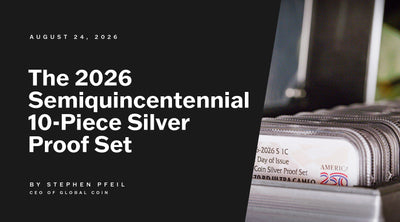
The 2026 Semiquincentennial 10-Piece Silver Proof Set: A Deep Dive Into America's 250th Anniversary
Key Takeaways The 2026 Semiquincentennial Silver Proof Set is the U.S. Mint's official commemora...
Discover More

Leave a comment
This site is protected by hCaptcha and the hCaptcha Privacy Policy and Terms of Service apply.