

The Spot Price of Gold: What It Really Means and Why I Watch It Every Single Day
Why I Start Every Day With the Gold Price Every morning before I even open my inbox, I check one number: the spot price of gold. That single figure tells me more about the state of the global economy, investor...

Why I Start Every Day With the Gold Price

Every morning before I even open my inbox, I check one number: the spot price of gold. That single figure tells me more about the state of the global economy, investor psychology, and geopolitical tension than most headlines ever could. It's not just a price. It’s a signal. A temperature check on the world’s faith in fiat currency, central banks, and future stability. And more often than not, it influences everything from central bank behavior to how collectors position themselves in uncertain times.
At the time of this article (Jan 10th 2025), gold is hovering around $4723 per ounce (check the live ticker in our website header)in U.S. dollars. To someone outside the industry, that may seem like a random number pulled from a chart. But in my world, that number reflects the balance of fear, faith, liquidity, and long-term value. And it’s one of the most closely watched benchmarks on earth.
What the Spot Price Actually Represents

When people ask me, “What is the spot price of gold?” I tell them it’s the price you’d pay for one troy ounce of gold if you wanted immediate delivery. That’s the key: immediate. This isn’t a futures contract. This isn’t a delayed settlement. It’s the real-time, ready-to-settle price of physical gold, traded globally through a network of banks, refiners, institutions, and bullion dealers.
There’s a common misconception that the spot price is just a single number pulled from a single source. In reality, it’s a composite derived from global trading across multiple time zones. The benchmark price that most people think of as the “official” spot price is actually set in London by the LBMA, or London Bullion Market Association. This is the organization that conducts two daily auctions—one in the morning, one in the afternoon—where major players place real orders for physical metal. These fixings set a formal global reference price, widely used for physical settlement and institutional contracts.
Why Spot Prices Fluctuate 24/7

But gold doesn’t sleep between those two auctions. Outside the LBMA fixings, trading continues nearly around the clock. From New York’s COMEX futures to Asian OTC transactions, the price of gold is in motion. The spot price you see on financial websites or metals platforms like Kitco or Bloomberg is an evolving consensus—partially driven by futures, partially by over-the-counter markets, and entirely dictated by supply, demand, sentiment, and speculation. That’s why data feeds from sources like Metals-API or LBMA affiliates show 24/7 fluctuations. Even when London sleeps, the world keeps trading.
COMEX vs. LBMA: The Two Engines Behind the Gold Price

People often ask about the difference between London spot pricing and COMEX gold. It’s an important distinction. COMEX pricing is derived from futures contracts traded in New York—primarily the front-month or most active contracts. These are financial instruments that settle in the future, and while they serve as a useful proxy for spot, they are technically not spot prices. On the other hand, London spot is based on actual physical gold, bought and sold today, with a focus on unallocated or allocated accounts. The LBMA standard is the 400-ounce Good Delivery bar, with a minimum purity of .995, and this is the size traded in settlement among banks, refineries, and major institutions.
The standard gold futures contract traded on COMEX represents 100 troy ounces of gold. When you see a COMEX price quote, it reflects the price per ounce, but the underlying contract size is for 100 ounces in total. While few participants take physical delivery, these contracts are physically deliverable through approved COMEX vaults. Most trading is speculative or used for hedging, but the 100-ounce size is a key structural detail that shapes liquidity and pricing behavior on the exchange.
Yet despite the different mechanisms, the prices are usually aligned within a narrow range. Arbitrage ensures that if a premium emerges between London and COMEX, traders step in to close the gap. It’s a dance between markets, where location, purity standards, and timing can create slight variations—but only for a moment.
Why Spot Matters More Than You Think

As someone who works with rare, investment-grade gold coins daily, I can tell you that the spot price is just the starting point. It sets the floor, not the ceiling. The coins we deal with—pieces with historical relevance, pristine grading, and ultra-low mintages—carry value well beyond melt. But even in our high-end world, spot matters. It’s the foundation of pricing, the backdrop to every conversation, and a constant presence in every valuation model.
What Actually Drives the Price of Gold

And let’s not forget what drives the price. Gold moves on more than just supply and demand. It reacts to inflation data, central bank decisions, currency volatility, and geopolitical crises. When confidence in traditional systems falls, gold rises. When the dollar weakens, gold strengthens. When fear enters the market, gold becomes the lifeboat.
There’s a reason central banks continue to buy gold by the ton. It’s not because they’re looking for quick returns. It’s because gold represents continuity in a world that is anything but predictable. It doesn’t default. It doesn’t evaporate in a banking crisis. It doesn’t need a board of directors or a bailout package. It just sits—quietly preserving wealth for those wise enough to hold it.
For Global Coin Clients, Spot Is Just the Beginning
For our clients at Global Coin—high-net-worth individuals, retirees planning a generational transfer of wealth, and collectors who view each coin as a piece of living history—understanding the spot price of gold is essential. Not because they’re trading it minute by minute, but because they understand the narrative. The story. The role gold plays as a hedge, a pillar, and a legacy asset.
So when someone asks me why I watch the spot price so closely, the answer is simple.
Because it never lies.
It reflects the truth of the moment, whether that truth is confidence or crisis. And in the world of rare coins and precious metal investing, truth is everything.
Questions I’m Asked About the Spot Price of Gold
What is the spot price of 1 oz of gold?
The spot price of gold is the current market price for one troy ounce of gold available for immediate settlement. When you see gold quoted on our website or on major financial platforms, that number reflects the real‑time global consensus price tied to the physical gold market, anchored by London’s bullion trade and influenced by continuous trading across time zones. It is not a retail price and it is not a futures contract. It is the baseline value of raw gold in its purest market form.
What’s the highest gold price has ever been?
Gold has reached historic all‑time highs multiple times, most recently breaking above the $4,700 per ounce level during periods of intense geopolitical uncertainty, aggressive central bank buying, and sustained inflation concerns. Each new high reflects not speculation alone, but a recalibration of trust in currencies and financial systems. Gold does not spike randomly. It climbs when confidence erodes elsewhere.
How big is $1,000 worth of gold?
At today’s spot prices, $1,000 represents just under a quarter of a troy ounce of gold. Physically, that amount of gold is surprisingly small. It could fit easily in the palm of your hand as a fractional coin or bar. This is one of gold’s most powerful attributes. Enormous value condensed into an object smaller than most people expect.
Do gold buyers buy at spot prices?
Retail buyers almost never purchase gold at pure spot. Spot is a wholesale reference price. Physical gold products carry premiums that reflect fabrication, transportation, insurance, dealer overhead, and market demand. However, every legitimate gold transaction begins with spot. It is the foundation upon which all pricing is built, whether you are buying a bullion bar or a rare numismatic coin.
Is it legal to own a 400 oz gold bar?
Yes, it is completely legal for a U.S. citizen to own a 400 troy ounce gold bar. These are known as Good Delivery bars and are the standard form of gold held by central banks, institutions, and large investors. While impractical for most individuals due to cost and storage considerations, ownership itself is not restricted.
Why is Warren Buffett against gold?
Warren Buffett has long argued that gold is a non‑productive asset. His philosophy centers on owning businesses that generate cash flow, dividends, and growth. From his perspective, gold simply sits there and does nothing. What Buffett leaves unsaid, however, is that gold’s role is not to outperform businesses in boom times. Its role is to preserve purchasing power when confidence in paper assets breaks down.
How much gold can a U.S. citizen legally own?
There is no legal limit. A U.S. citizen may own as much gold as they choose, whether in coins, bars, or bullion products. Restrictions that once existed during the 1930s are long gone. Today, gold ownership is fully legal and unrestricted.
Why does Dave Ramsey say not to invest in gold?
Dave Ramsey generally discourages gold because it does not produce income and can be volatile in the short term. His investment philosophy prioritizes long‑term growth through equities and income‑producing assets. Where Ramsey’s advice often diverges from high‑net‑worth strategy is in gold’s role as insurance rather than speculation. Gold is not designed to replace growth assets. It is designed to protect what growth has already created.
What if I invested $1,000 in gold 10 years ago?
Ten years ago, gold was trading at a fraction of today’s price. A $1,000 investment made then would be worth substantially more today, even before accounting for premiums on physical gold products. While gold does not move in a straight line, its long‑term trajectory reflects its role as a hedge against inflation, currency debasement, and systemic risk.
Is Costco Gold worth it?
Large retailers offering gold have introduced convenience into the market, but convenience is not the same as strategy. While pricing can sometimes be competitive, buyers still need to evaluate purity, premiums, authentication, and resale liquidity. Serious investors typically prioritize reputable dealers, proper documentation, and long‑term marketability over novelty access points.
How much is a 1980 $200 gold coin worth?
The value of a 1980 $200 gold coin depends on its gold content, condition, and collector demand. Its intrinsic value rises with the spot price of gold, while any numismatic premium depends on rarity and market interest. These coins are often worth significantly more today than at the time of issue, even without accounting for gold’s appreciation.
Will gold hit $5,000 an ounce?
Gold reaching $5,000 per ounce is no longer a fringe idea. It is increasingly discussed in mainstream financial circles as global debt expands, currencies weaken, and central banks continue accumulating gold. Whether it happens this year or several years from now, the trajectory reflects structural forces rather than hype.
Why is it illegal to own a $20 gold piece from 1933?
The 1933 $20 Double Eagle holds a unique legal status because it was never officially released into circulation before the U.S. government restricted gold ownership. Most examples were ordered melted, and surviving specimens are considered government property unless explicitly authorized. This makes it one of the most famous and legally complex coins in U.S. history.
How much is 20 pounds of gold worth?
Gold is measured in troy ounces, not standard pounds. Twenty pounds of gold equals approximately 292 troy ounces. At current spot prices, that amount of gold would be worth well over one million dollars. This calculation alone demonstrates how efficiently gold stores value.
What is a good amount of gold to own?
There is no universal answer, but many sophisticated investors allocate between 5% and 10% of their net worth to gold. The right amount depends on risk tolerance, portfolio composition, and long‑term goals. Gold is not about maximizing upside. It is about minimizing regret during periods of instability.
Related Articles
Paper Promises vs. Physical Reality: Why China Just Shut Down Paper Gold
I’m Stephen Pfeil, founder of Global Coin. It has been almost two months since I published When T...
Discover More
The 2026 Semiquincentennial 10-Piece Silver Proof Set: A Deep Dive Into America's 250th Anniversary
Key Takeaways The 2026 Semiquincentennial Silver Proof Set is the U.S. Mint's official commemora...
Discover More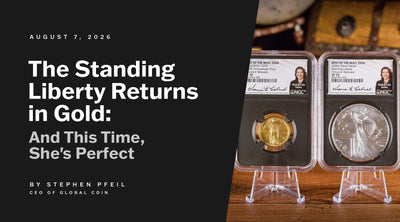
The Standing Liberty Returns in Gold — And This Time, She's Perfect
The Standing Liberty Returns in Gold — And This Time, She's Perfect There are coins you collect, ...
Discover More

Leave a comment
This site is protected by hCaptcha and the hCaptcha Privacy Policy and Terms of Service apply.